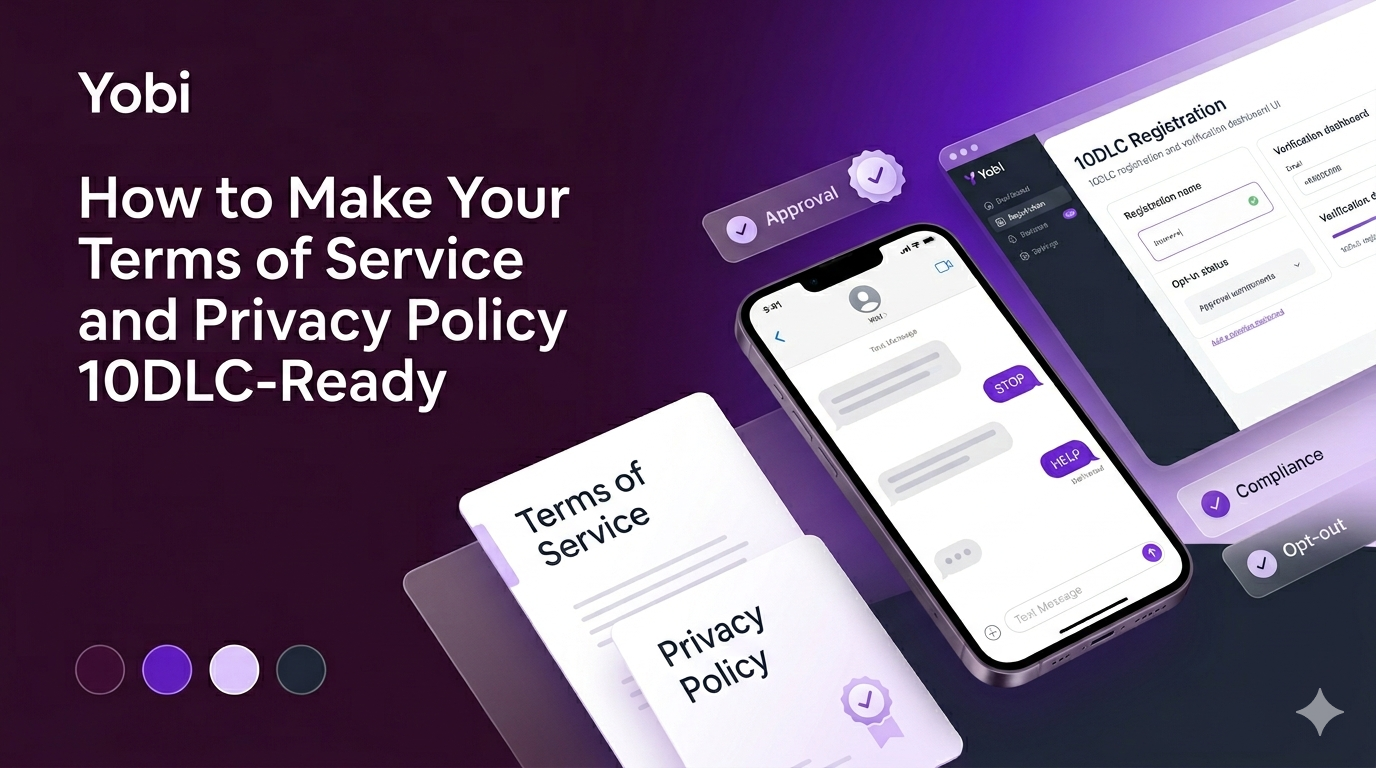

If you want to send SMS through Yobi in the United States, your business needs more than a registered brand and approved campaign. Carriers also expect your website to clearly explain how people consent to messaging, what kinds of messages they will receive, how often they may hear from you, and how they can opt out.
That is where your Terms of Service and Privacy Policy matter.
This guide explains what Yobi customers should include in those pages to support 10DLC registration and reduce the risk of message filtering, campaign rejection, or compliance issues.
What 10DLC Compliance Means
10DLC stands for 10-digit long code. It is the standard U.S. carrier system for application-to-person texting from local phone numbers.
To send compliant SMS traffic, businesses generally need to register their brand and campaign, describe the purpose of their messaging, collect clear customer consent, provide an easy opt-out path, follow carrier rules for message content and volume, and publish clear public-facing legal and privacy disclosures.
For Yobi customers, that means your registration details, website forms, Terms of Service, and Privacy Policy should all tell the same story.
Why This Matters
Carriers want proof that your messaging program is legitimate, transparent, and permission-based.
If your public pages are vague, missing, or inconsistent with your registration, your 10DLC campaign may be delayed, rejected, or flagged later.
A strong Terms of Service and Privacy Policy helps show that customers know what they are signing up for, your business handles consent properly, opt-out instructions are clear, your data practices are transparent, and your messaging program is tied to a real business process.
Terms of Service vs Privacy Policy
These two pages do different jobs.
Terms of Service explains the rules for using your service and receiving your communications. It should cover consent, message types, message frequency, opt-out instructions, and any liability disclaimers.
Privacy Policy explains what personal information you collect, how you use it, how you protect it, and whether you share it.
In short: Terms of Service explains the messaging relationship, while Privacy Policy explains the data relationship. You need both.
What to Include in Your Terms of Service
1. Consent to receive messages
Your Terms should explain how a customer gives consent and what they are agreeing to receive.
Include how consent is collected, whether messages are transactional, conversational, promotional, or mixed, and a statement that consent is not a condition of purchase, if applicable.
Sample copy: By providing your phone number and agreeing to receive messages, you consent to receive SMS communications from [Company Name], including transactional, conversational, and, where applicable, promotional messages related to our services. Message frequency may vary. Consent to receive messages is not required as a condition of purchase.
2. Opt-out instructions
Customers must be able to stop messages easily.
Include how to opt out, what keyword to use, and what happens after they opt out.
Sample copy: You may opt out of SMS messages at any time by replying STOP to any message. After you opt out, you will no longer receive SMS messages from us except as needed to confirm your opt-out or as otherwise permitted by law.
3. Help instructions
It is good practice to tell users how to get help.
Sample copy: For help, reply HELP to any message or contact us at [support email] or [phone number].
4. Message frequency and message type
Tell users what kinds of messages they may receive and how often.
Include appointment reminders, support follow-ups, account alerts, promotional offers if used, and expected frequency or a statement that frequency varies.
Sample copy: Message frequency may vary depending on your interaction with our business. Messages may include appointment reminders, service updates, account notifications, customer support messages, and promotional messages where you have provided consent.
5. Message and data rates notice
This is standard carrier language.
Sample copy: Message and data rates may apply.
6. Delivery disclaimer
You should not promise guaranteed delivery.
Sample copy: Message delivery is subject to your mobile carrier and is not guaranteed. [Company Name] is not responsible for delayed or undelivered messages.
What to Include in Your Privacy Policy
1. What information you collect
Be specific about the types of personal data you collect.
Include name, phone number, email address, appointment or inquiry details, and website usage data if relevant.
Sample copy: We may collect personal information such as your name, phone number, email address, and other information you provide when you submit a form, schedule an appointment, contact us, or communicate with us by text message.
2. How you use the information
Explain how that data supports your service.
Include customer support, scheduling, account communication, service delivery, marketing if applicable, and legal or operational compliance.
Sample copy: We use your information to provide services, respond to inquiries, send requested communications, manage appointments, improve our operations, and comply with legal obligations.
3. How you protect the information
Explain your security posture at a high level.
Sample copy: We use reasonable administrative, technical, and organizational safeguards to protect your personal information against unauthorized access, disclosure, alteration, or destruction.
4. Non-sharing of mobile information for marketing
This is one of the most important pieces for 10DLC-related review.
Recommended copy: Mobile information will not be shared with third parties or affiliates for marketing or promotional purposes. Text messaging originator opt-in data and consent will not be shared with any third parties, except with vendors or service providers that support message delivery and business operations.
5. Opt-out language
Your Privacy Policy should also explain how someone can stop text messages.
Sample copy: You may opt out of SMS communications at any time by replying STOP to any message. You may also contact us directly for assistance with your communication preferences.
6. Policy updates
Tell users how changes will be handled.
Sample copy: We may update this Privacy Policy from time to time. When we do, we will revise the Last Updated date on this page. Continued use of our services after changes become effective constitutes acceptance of the updated policy.
Best Practices for Yobi Customers
If you are setting up 10DLC messaging in Yobi, use this checklist:
- Make sure your Terms of Service and Privacy Policy are publicly accessible.
- Include your business name exactly as it appears in registration.
- Make sure your opt-in language matches your actual workflow.
- State what message types users will receive.
- Include STOP and HELP instructions.
- Include "Message and data rates may apply."
- Include the mobile non-sharing statement in your Privacy Policy.
- Make sure your web forms and campaign description match each other.
- Avoid vague claims like "alerts" if you are actually sending promotions.
Common Mistakes to Avoid
- Missing Terms of Service or Privacy Policy links on your website.
- Using generic legal pages that never mention SMS.
- Failing to describe opt-in clearly.
- Not listing opt-out instructions.
- Saying one thing on your form and another in your campaign registration.
- Omitting the statement about not sharing mobile data for marketing.
- Using promotional messaging without clearly disclosing it.
Practical Next Step for Yobi Customers
Before submitting or resubmitting your 10DLC registration, review these four items together:
- Your website form language.
- Your Terms of Service.
- Your Privacy Policy.
- Your campaign description in Yobi.
If those four pieces are aligned, your registration is much more likely to move smoothly.
FAQ
Do I need both a Terms of Service and a Privacy Policy for 10DLC?
Yes. Carriers and registration reviewers typically expect both. One explains the messaging rules. The other explains the data practices.
Do I have to mention SMS specifically?
Yes. Generic legal language is often not enough. Your pages should clearly mention text messaging, consent, opt-out instructions, and message frequency.
What opt-out language should I use?
The standard approach is to tell users they can reply STOP to opt out and HELP for assistance.
Should I include promotional messaging if I only send reminders?
No. Your language should reflect what you actually send. If your messages are only appointment reminders and service updates, say that plainly.
What is the most important Privacy Policy clause for 10DLC review?
The clearest high-priority item is your explanation of mobile data handling, especially that mobile opt-in data is not shared with third parties for marketing or promotional purposes.
Can Yobi complete this for me?
Yobi helps with business verification and messaging setup, but each business is still responsible for the content on its public legal pages and for ensuring that its disclosures match its actual messaging practices.
About Yobi: Yobi provides AI employees for healthcare practices and service businesses, enabling 24/7 appointment scheduling, customer communication, and messaging workflows across voice, SMS, and digital channels. Learn more at yobi.com.